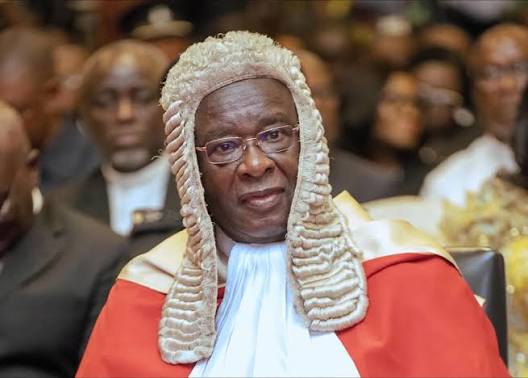
Chief Justice Paul Baffoe-Bonnie’s comments during a visit to the Minerals Income Investment Fund (MIIF) have raised questions about the political neutrality expected of judicial officers under the Code of Conduct for Judges and Magistrates.
Speaking at MIIF, the Chief Justice referred to President John Dramani Mahama as the “old man” and described the President’s agenda as one that would benefit the country.
“The old man’s agenda is an agenda that will benefit the nation and we cannot say that we are the best in the land,” he said.
He further stated that President Mahama’s decision to appoint an individual to the position demonstrated the confidence the President had in that person.
“If the old man has said that you are the best person out of the 30 million in the land, then it means he has a lot of confidence in you,” the Chief Justice said.
He subsequently urged officials to support the President’s agenda.
“We should do everything to make sure that his agenda succeeds,” he added.
The comments are being juxtaposed with Rule 6 of the Code of Conduct for Judges and Magistrates, which deals with political and quasi-political activity.
The rule states that “a judge should refrain from political activity inappropriate to his judicial office.”
Under the section on political conduct in general, the Code provides that, notwithstanding Article 55(2) of the 1992 Constitution, a judge or a candidate for appointment to judicial office should not act as a leader or hold office in a political organization, publicly endorse or oppose another candidate for political office, make speeches on behalf of a political organization, or attend political gatherings.
The Chief Justice’s remarks have nevertheless drawn attention because of his direct reference to the President’s agenda and his call for officials to do everything possible to ensure its success.
The comments come in the wake of the Chief Justice’s engagements with state institutions, including MIIF and the Social Security and National Insurance Trust (SSNIT), as part of his interactions with public institutions.
The development has consequently sparked debate over whether such public expressions of support for the agenda of a sitting President are consistent with the standards of political neutrality required of judicial office holders.